总览回放 / Overview replay
📖 This is the concise version (~3 min). For the full engineering details (design decisions, algorithm / reward, diagnostics, reproduce commands), read the deep-dive →
UniLab & Joint Release
UniLab is a heterogeneous robot-RL training
infrastructure: CPU-parallel physics simulation (MuJoCo / Motrix) and GPU policy
learning are coupled through a unified runtime and shared memory — instead of pinning
physics, rollout collection, and learning on a single GPU-resident simulation path. Tasks,
rewards, and backend selection are expressed as Hydra owner YAMLs; training goes through a
unified uv run train / uv run eval CLI covering PPO, SAC, TD3, APPO, and more.
We are jointly releasing this practice alongside our system paper UniLab: A Heterogeneous Architecture for Robot RL Beyond GPU-Dominant Paradigms (arXiv:2605.30313). The paper argues that efficient training is not about which processor runs physics, but whether simulation throughput, policy updates, and runtime synchronization form an efficient end-to-end loop — GPU simulation is an effective path, but not a necessary one. On representative robot-control tasks, UniLab improves end-to-end training efficiency by 3–10× under the same hardware, reduces dependence on the NVIDIA CUDA stack, and natively supports AMD ROCm, Intel XPU, and Apple macOS.
On AMD platforms, ROCm is first-class: make sync-rocm sets up the environment; policy
learning runs on CUDA / MPS / ROCm / XPU accelerators while physics stays on
CPU-multithreaded simulation. This OpenArm grasp experiment is a rocPAI-Forge Physical AI
practice built on UniLab atop Instinct MI300X / MI210 + ROCm.
- Code: github.com/unilabsim/UniLab
- Paper: arXiv:2605.30313
- Docs: UniLab-doc
Overview
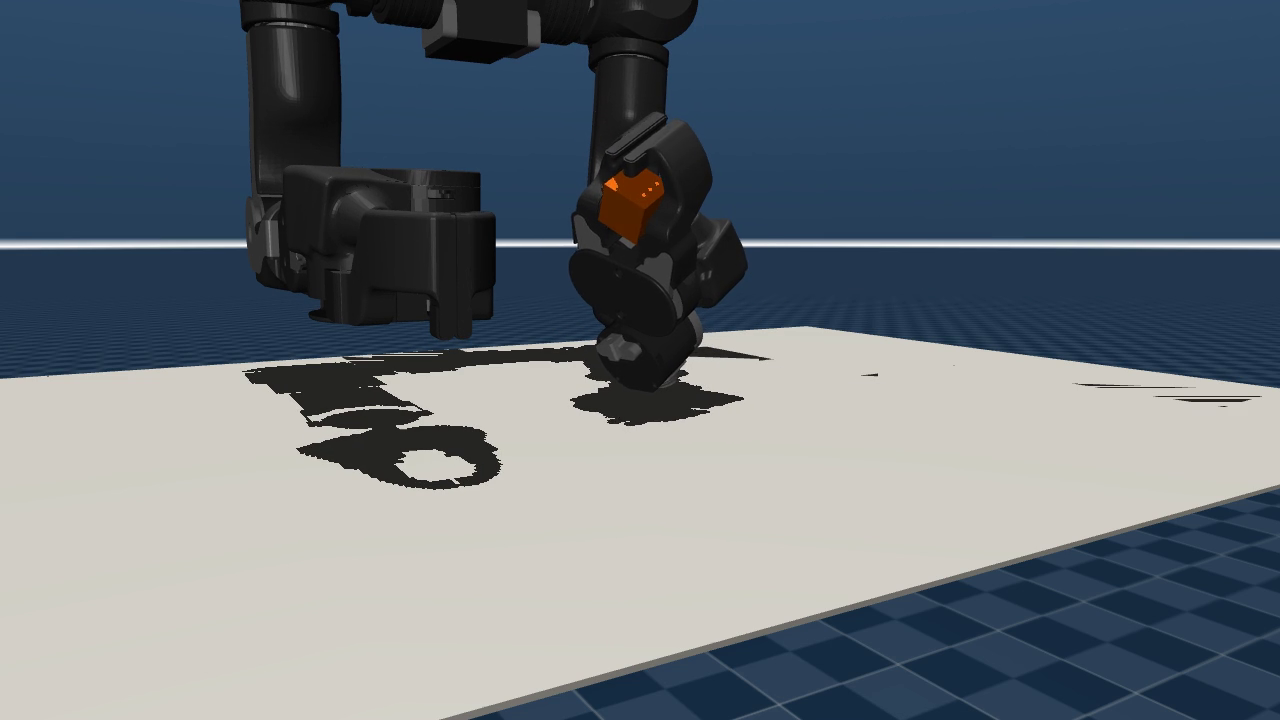
On UniLab we trained a PPO grasp policy for a single OpenArm: pick a 3 cm cube off the table, lift it to an in-air goal, and hold it.
Final deterministic eval: ever-success 100%, final-success 87.9%, drop rate 0%. But the interesting part is three moments along the way.
Three interesting moments
1. A gripper that actually closes is hard. A binary snap-close gripper is easy
mode; switching to continuous control, the policy kept getting stuck in a
“grab but never lift” local optimum. Staged shaping (open-above → descend → close →
lift) plus one trick — terminate_on_success=false (don’t end on success, keep
paying it to hold) — finally taught it the full motion.
2. It learned to cradle, not clamp. 🌟 At eval the policy almost never closes its fingers (closure ≈ 0), yet lifts the cube 100% of the time — it cradles the cube between two fingertips. We assumed a bug; then it clicked: for this high-friction, small cube, a fingertip cradle leans on geometry + friction and is more robust than precise clamping. The harder we forced clamping, the worse the primary objective got. RL’s most fascinating trait: it doesn’t solve the problem you posed — it solves the easier, better one it discovered.
3. One wild curve, saved by one hyperparameter. 🌟 Success plateaued around
iter ~600, but action std climbed to 39. Why: after tanh saturation,
inflating the exploration noise barely changes the executed action, so PPO found a
“free entropy lunch” — inflate std, collect entropy bonus, reward doesn’t drop.
Harmless to control, but it makes curves ugly and hides that the policy converged
long ago. The fix: lower entropy_coef from 0.01 to 0.003 (nothing else
changed):
| Metric | baseline 0.01 | lowent 0.003 |
|---|---|---|
| ever success | 98.8% | 100.0% |
| final success | 86.3% | 87.9% |
| final reward | 2580 | 2800 |
| final action std | 39.08 | 1.35 |
Not a “trade success for clean curves” deal — a net win. And the change touched no Python: just a new owner-variant YAML overriding a single field — UniLab’s “config-first, fix-at-owner-layer” principle (traceable, comparable, revertible).
Three takeaways
- Config first: express ideas as config, not code — cheap, traceable experiments.
- Validate near the risk: “success didn’t drop” isn’t all-clear — watch every curve.
- Let evidence speak: a counter-intuitive result is often evidence — understand before you judge.
Training scale: 4096 parallel envs × 24 steps/iter × 1500 iter ≈ 147.5M sim steps, ~1h49m per run (shared GPU, ~23k steps/s). To reproduce and see the full reward/curve analysis → deep-dive. See also: UniLab PR #640.
📖 Want more? Full engineering details in the deep-dive.